

NATO Science for Peace and Security (SPS) Programme
The NATO Science for Peace and Security (SPS) Programme promotes security-related practical cooperation based on scientific research, innovation and knowledge exchange within NATO’s wide network of partner countries.
It connects scientists, experts and officials from Allied and partner countries to address security challenges, such as cyber defence, counter-terrorism or defence against CBRN agents; to support NATO-led missions and operations; to foster the development of security-related advanced technologies such as sensors and detectors, nanotechnologies, unmanned aerial vehicles (UAVs); and to address human and social aspects of security such as the implementation of United Nations Security Council Resolution 1325 on Women, Peace and Security (UNSCR 1325).
DIMLAB
Deployable CB analytical laboratory.
Application of nano-bio technology.
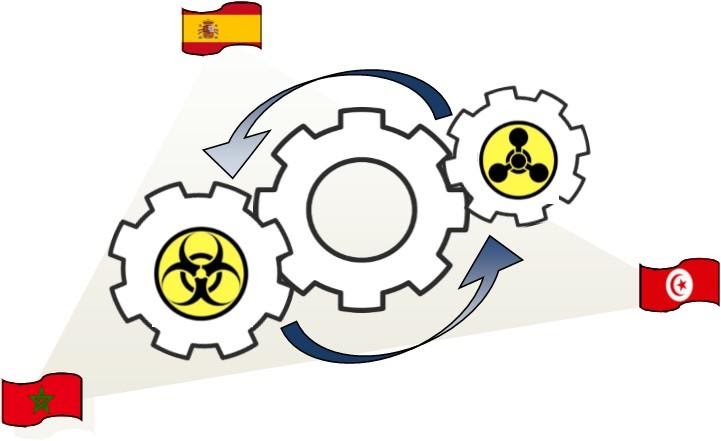
The main objective of DIMLAB project (SPS G5571) is to heighten chemical and biological threat response capability through deployable field laboratories and to strengthen cooperation in the fight against terrorism in the framework of NATO.
DIMLAB project proposes to design and build a chemical & biological laboratory by using the latest advances in nano & bio technology, under the guidance of experienced end users and validation by a reference defence laboratory. The project will focus on developing a working CB turn-key solution and sharing knowledge and experience. This is a joint Spanish, Tunisian and Moroccan initiative involving young scientists in academia guided by CBRN experienced end users.
The DIMLAB project is supported by the NATO SPS Progamme.
Project news
ADELFAS amplía las capacidades de los usuarios finales del laboratorio DIM_LAB bio con la tecnología nanopore.
Los días 20 y 21 de julio se realizó, dentro del marco del proyecto DIMLAB, un curso de formación con el objetivo de capacitar a los usuarios finales del laboratorio biológico desplegable en la secuenciación en tiempo real. El laboratorio desplegable DIM-LAB BIO...
Puesta en marcha y entrega del laboratorio DIMLAB Bio en Marruecos
ADELFAS, ejecutor del proyecto DIMLAB, envió una delegación a Rabat los días 17, 18 y 19 de enero para entregar oficialmente el laboratorio biológico desplegable a los usuarios finales en Marruecos. Los dos primeros días de esta misión tuvieron lugar en las...
Proyecto SPS DIM-LAB de la OTAN: Reunión de expertos técnicos y formación en Madrid de usuarios finales marroquíes del laboratorio biológico móvil
Durante dos semanas, del 18 al 29 de julio, ADELFAS y los usuarios finales marroquíes celebraron una Reunión de Expertos Técnicos para validar el cumplimiento del laboratorio móvil de nivel 3, diseñado y construido bajo el liderazgo de ADELFAS, e intercambiar sobre...
News from the web
News From The Web
Originall publishe by gov.uk Advances in AI are creating unprecedented opportunities for scientific discovery, but they are also changing the biological risk landscape. AI can accelerate research, improve our understanding of diseases, and support the discovery and development of new medical countermeasures. However, increasingly capable AI systems also create new biological risks and could lower barriers to harmful activity. The UK is committed to harnessing the benefits of AI while strengthening resilience to biological threats. That’s why, as part of a National AI Biosecurity Initiative, the government is establishing the AI Biosecurity Lab (AIBL). The AI Biosecurity Lab will be [...]
Four new micro-credentials launching in November will provide healthcare professionals and first responders with flexible, industry-informed education in CBRNE preparedness and response. The George Washington University College of Professional Studies (CPS) and First Line Technology today announced a new partnership to develop a series of professional-focused micro-credentials in chemical, biological, radiological, nuclear, and explosive (CBRNE) preparedness and response. The collaboration brings together the university’s expertise in developing high-quality, career-focused education for working professionals with First Line Technology’s more than two decades of experience equipping and training organizations around the world that face complex CBRNE and emergency-response challenges. The first four [...]

Teledyne FLIR Defense, part of Teledyne Technologies Incorporated, today announced that the Department of Homeland Security’s Countering Weapons of Mass Destruction Office (CWMD) has placed a $6 million order of identiFINDER® R425 handheld radionuclide identification devices. Managed through the Federal Emergency Management Agency (FEMA), this most recent award builds on the company’s 19-year history supporting CWMD’s Securing the Cities initiative. Bound for fire departments, emergency management agencies, and police departments, the new R425 handheld radiation detection units will expand security capabilities for first responders tasked with safeguarding the country’s most densely populated regions. Teledyne FLIR Defense has been equipping the [...]
The United States has become the latest nation to place an order for Avon Protection’s MITR System. The recent order by the Department of War (DoW) incorporates the MITR-M1 Half Mask and MITR-PG1 Powered Goggle for its Special Operations Forces, and includes both MITR-PF Particulate Filter and MITR-RF Riot Filter for mission-specific modularity, and integrated helmet and communication system accessories. The MITR System delivers modular protection for eyes, nose and mouth as an alternative to full-face respirators, allowing users in tactical threat environments to scale up their protection during dynamic, fast-paced missions. The NIOSH-certified MITR-M1 Half Mask with MITR-PF Filter [...]
As with many news stories emanating out of Russia, the sensational death of a lab scientist (potentially) from Y.Pestis is surrounded by denials and misinformation. Verifiable information is non-existent or opaque at best, and a lot of what is being published is speculation due to lack of information. That said… perhaps there is some value to a discerning eye looking at the situation, contextualizing it, and maybe adding some insight. In terms of definites… a 28-year-old lab worker/researcher is reported to have died around October 2 after coming down with a pneumonia like illness. Since then, news has been filled [...]
Minerva Robotics have launched a new humanoid robot to deal with hazmat, EOD and CBRN tasks. Their website gives me a headache to navigate, but it'll give you the gist. Official press release below: A robotics company building humanoid robots for the world’s most dangerous jobs in onshore and offshore oil and gas operations and public safety, today announced it has raised approximately $10 million in pre-seed funding led by General Catalyst, with Long Journey Ventures and Credo Ventures as co-leads, and participation from MVP Ventures, Kaya, RunwayVC, Compound, Founders Embassy, Hugging Face, Codecademy, YG, Walter Ventures, Tiny Ventures, Chaotica, and [...]
Originally published by https://ukdefencejournal.org.uk/ A support contract worth an estimated £39 million is being lined up to keep the equipment Britain uses to detect chemical, biological, radiological and nuclear threats in working order, according to a pipeline notice published by Defence Equipment and Support. The notice is an advance warning rather than a competition, issued to give industry time to prepare for work that will not go to tender until the middle of next year. Suppliers are told the tender notice itself is expected around 15 June 2027, with the contract running from 1 April 2028 to the end of [...]
That's right, there is only 1 week until CBRNe Convergence 2026 kicks off in Knoxville, Tennessee. If you havent booked yet, don't worry, there is still time https://cbrneworld.com/knoxville26 There is an excellent programme for this year's event, including 4 specialist workshops, a programme filled with national and international speakers, and a special afternoon session dedicated to all things CBRN medical. You can find the full programme here CBRNe Convergence is the place where responders, military, and experts prepare for what’s next, join us and prepare for your next challenge. [...]
FEMA’s Center for Domestic Preparedness (CDP) officially opened its new student training and in-processing center at its Advanced Responder Training Complex. Department of Homeland Security Under Secretary for Management Brian Cavanaugh participated in the ribbon-cutting ceremony. He was joined by FEMA Administrator Cameron Hamilton, DHS Deputy Under Secretary for Management Erin Hoffman, Center for Domestic Preparedness Acting Superintendent Chris Chesney, FEMA’s National Preparedness Directorate Deputy Assistant Administrator Dr. Thom Layou and other distinguished guests. “The men and women who respond first when disaster strikes deserve the very best training and resources we can provide,” said DHS Under Secretary for Management [...]
Thanks to a notification from NewsGuard's Reality Check it has been made known to us that some 'influencers' are promoting the consumption of 'radium water'. This isn't a new thing, in the 1920's a radioactive medicine called Radithor was sold and advertised as a cure for the living dead and perpetual sunshine. Among the many ailments it claimed to cure were high blood pressure, rheumatic diseases, and even mental illness! All of which were of course disproved. According to Newsguard, the false claim of healing radioactive water has been resurrected, thanks to Matt Roeske, a health influencer and owner of [...]
Originally published by https://www.army.mil/ 1st Special Forces Command (Airborne) hosted its semiannual Dragon Sage exercise at Dugway Proving Ground from Aug. 29 to Sept. 12, 2026. The two-week exercise evaluates the combat readiness of chemical, biological, radiological and nuclear specialists across chemical reconnaissance-decontamination teams (CRDT) within the formation. Ultimately, it assesses and strengthens CRDT proficiency in preparation for operational alignment with a Special Forces battalion. “The exercise typically evaluates 42 Soldiers across six teams on CBRN skills,” said Capt. Justin Carollo, a CBRN officer assigned to 1st SFC (A). “It is primarily designed for 74-series Soldiers supporting Special Operations Forces, [...]

DHS S&T are seeking the development and demonstration of computational, artificially intelligent algorithms to detect known, novel, and unknown biological threats in environmental metagenomic datasets. The goal is to develop innovative algorithmic approaches capable of recognizing the fundamental hallmarks of biological threats of all types, ensuring the U.S. is protected against the known dangers of today and the unseen threats of tomorrow. Key Dates and Prizes Opening date for submissions: Tuesday, September 8, 2026 Closing date for submissions: Wednesday, October 14, 2026 - 1200 EDT The total cash prize pool is $999,990. The Challenge is open to all eligible individuals [...]
Former head of the Federal Bureau of Investigation's (FBI) National Security Branch joins Argon to help response teams train against the threats they will actually face Argon Electronics has appointed Jill Sanborn as a strategic advisor. Sanborn retired from the Federal Bureau of Investigation (FBI) as Executive Assistant Director of the National Security Branch, the part of the Bureau responsible for counterterrorism, counterintelligence and weapons of mass destruction programmes. For more than three decades, Argon has built detector simulators that allow military chemical, biological, radiological and nuclear (CBRN) units, fire and hazardous materials (HazMat) teams, police and explosive ordnance disposal [...]